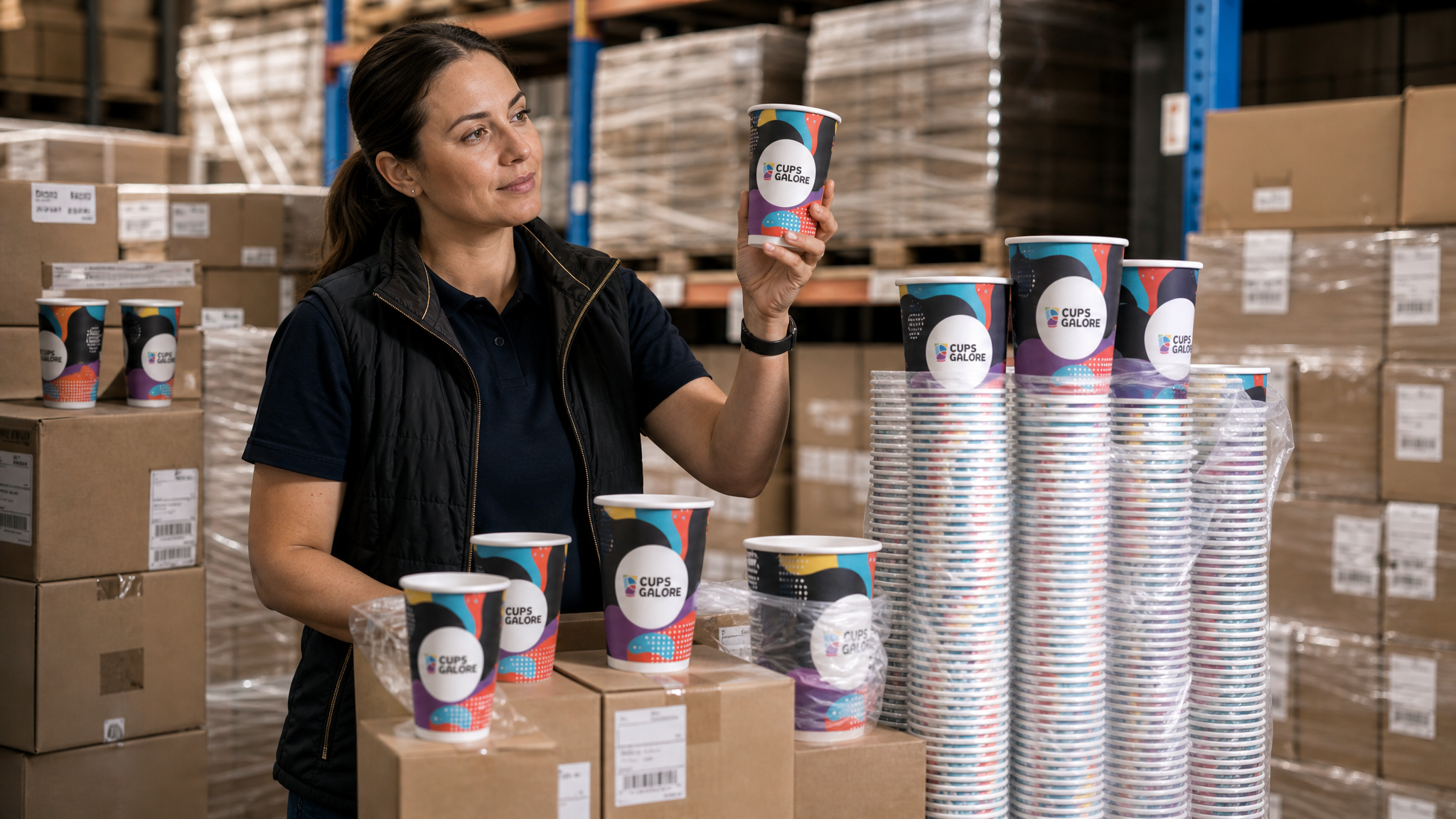
Cafe franchises grow on the promise of consistency. The customer walks into any site and gets the same coffee, the same experience, the same brand. When that promise breaks, the brand equity built at the flagship site erodes across the network.
Cup supply is one of the quiet ways franchise consistency breaks. Different sites use different suppliers because the founder went with whoever was cheapest in each region. Print quality varies. Colour drifts between production runs. Franchisees complain to head office. Head office does not know how to fix it because the supply is fragmented across three or five suppliers, none of whom are accountable to the network as a whole.
Here is how the best-run multi-site cafe groups in Australia manage cup supply consistently, and what the transition to a standardised program looks like.
The three failure modes of fragmented cup supply
Colour drift between production runs. Different suppliers, different equipment, different ink formulations. Even when everyone is trying to hit the same Pantone, results vary. Customers do not consciously notice colour drift between sites but they do notice when their local cafe cup does not look quite right compared to the one they had last week in another city.
Inconsistent stock availability. Some sites have cups. Some do not. Head office cannot see the pattern because it lives across multiple suppliers.
No accountability when things go wrong. A cup arrives off-brand at a site. The franchisee complains. Head office contacts the supplier serving that region. The supplier says the artwork was fine on their end. There is no single team with visibility across the whole network to actually fix the problem.
What standardised cup supply looks like
Three operational elements.
One supplier, one specification. A single supplier producing the same specification cups across every site in the network. Colour, finish, size and construction locked in a master specification document that governs every production run.
One artwork file per size, brand-locked. The artwork lives at head office. Franchisees do not modify it. The supplier prints from the same file for every production run.
Central ordering with site-level distribution. Orders placed centrally by head office or the franchise operations team. Deliveries scheduled to each site based on actual usage patterns. Franchisees are freed from the operational cost of managing their own cup supply.
The transition to standardised supply
Rolling a franchise network onto a single cup supplier is not an overnight change. Sites have existing stock. Franchisees have existing supplier relationships. The transition has to be phased.
The best transitions we have seen follow this pattern.
Phase one: Master specification and artwork. Head office locks the specification and finalises the master artwork before any site conversation happens.
Phase two: Initial production run. The new supplier produces the first standardised run at volume, held in warehouse ready for distribution.
Phase three: Regional rollout. Sites transition to the new supply on a regional basis, over 8 to 12 weeks. Existing stock at each site is run down before the new stock arrives.
Phase four: Ongoing supply cadence. Monthly base orders per site with top-up cycles as needed. Central visibility on stock at every site.
Done properly, no site runs out of stock through the transition and every site is on the standardised supply within a quarter.
What the franchise operations team gets back
Three things.
Reclaimed time. The administrative overhead of managing cup supply across multiple suppliers disappears. Head office and franchisees stop having the same conversation about cup consistency every quarter.
Visibility. Stock levels at every site visible centrally. Reorder cycles predictable. Supply risk manageable rather than reactive.
Brand equity. Every customer at every site holds the same cup, printed to the same specification, with the same colour and finish. The brand promise the franchise sold to franchisees is actually delivered.
The unit economics angle
Consolidated supply usually improves unit cost. Volume discounts on a national program outperform the pricing of fragmented regional supply. The exact saving depends on the network size and previous supplier mix, but the direction is consistent.
For most franchise networks moving to standardised cup supply, unit cost comes down and consistency goes up.
The takeaway
Cup supply is one of the operational levers that separates well-run franchise networks from struggling ones. Standardised supply through a single accredited supplier reduces cost, improves consistency, and frees up head office and franchisee time.
Cups Galore runs standardised cup supply programs for multi-site cafe networks across Australia. Central ordering, national distribution, brand-locked specifications.
Talk to us about your franchise cup program.