Rush orders on custom paper cups sit somewhere between two common misconceptions. The buyer thinks it means paying more for the same thing, faster. The supplier hopes the buyer thinks that.
The reality is more operational. A rush order rearranges production scheduling, prioritises quality control in a compressed window, and creates specific risks that a standard-lead-time order does not. Some are manageable. Some are worth understanding before you commit.
Here is what actually happens when a rush order goes through a serious paper cup manufacturer, and what buyers should know before requesting one.
What "standard" and "rush" actually mean
Standard lead time on custom paper cups is 7 to 10 business days from artwork approval to production complete, plus 2 to 5 business days for delivery within Australia. This is a fully-scheduled production run that fits into the normal manufacturing queue.
Rush lead time compresses that window, typically to inside 5 business days for production, sometimes faster. The compression is real. Something has to change operationally to make it work.
The suppliers who genuinely handle rush at scale build spare capacity into their production planning specifically for this. The suppliers who cannot handle rush at scale will accept the brief and then miss it, which is worse than declining.
What has to happen operationally for a rush order to work
Four things.
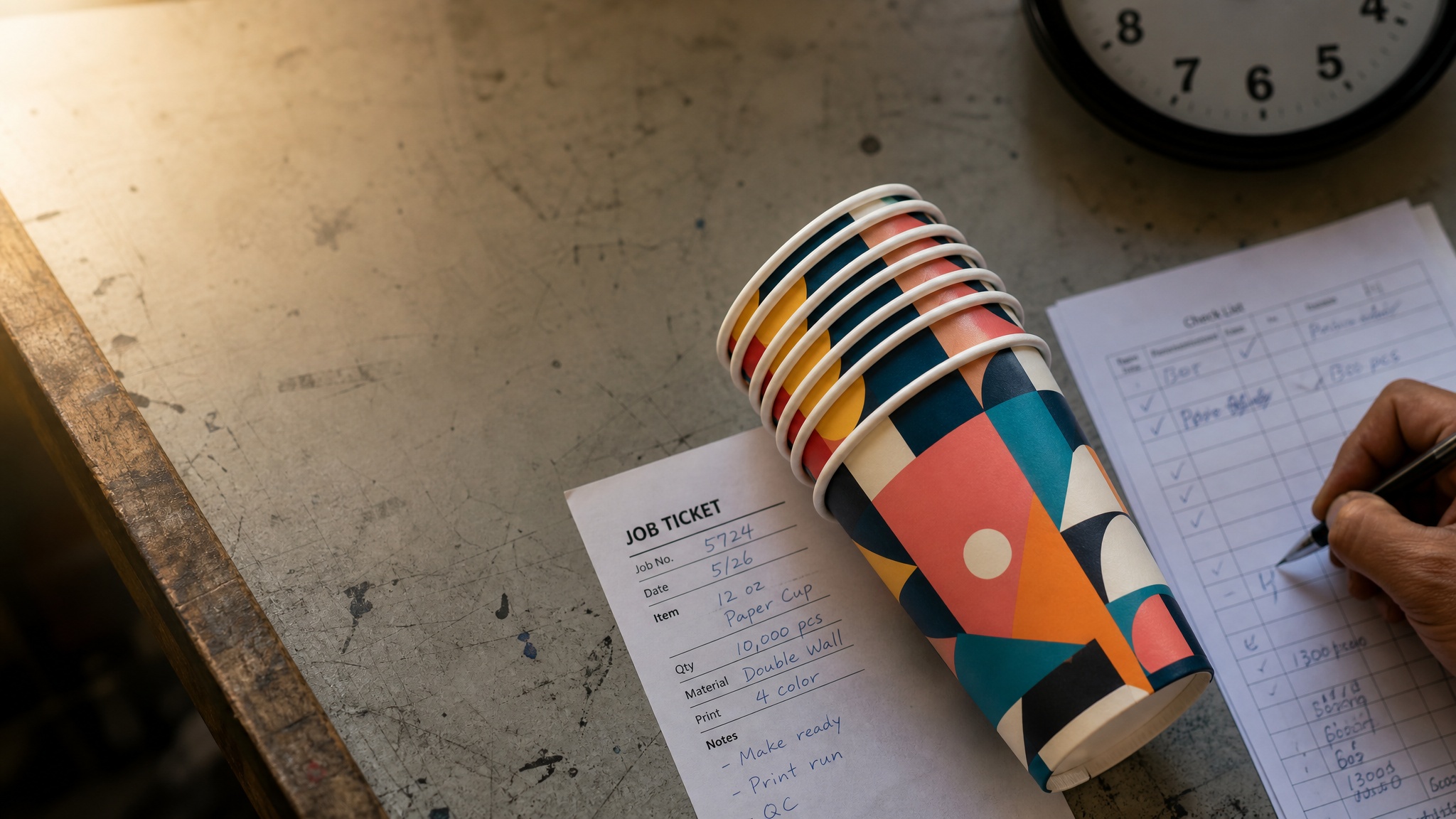
Production scheduling. The rush job has to be inserted into a queue that was already scheduled. That means either running an extra shift, using idle capacity that was held for rush work, or bumping a lower-priority job. Each of these has knock-on effects.
Artwork turnaround. Rush timing usually means artwork approval on the first proof. That requires a client team that can make brand decisions fast and sign off in writing without a three-day review cycle.
Quality control compression. QC on rush jobs runs in a shorter window. Serious suppliers hold the same QC standards on rush that they do on standard, which means allocating more people to the QC step, not shortcutting it.
Dispatch and delivery. Rush production usually means courier delivery rather than standard freight. Cost differential shows up here.
What rush costs
Rush pricing varies by supplier and by how much production has to be reorganised. The cost is not arbitrary. It reflects real operational trade-offs.
For buyers, the useful mental model is that rush is a scheduling premium, not a quality compromise. The cup that arrives from a rush run should be indistinguishable from the cup that arrives from a standard run. If it is not, the supplier is cutting corners under time pressure, which is a different problem.
When rush is the right answer
Three scenarios.
Genuine timeline collapse. An event has moved forward, a supplier has failed, a launch date has been brought in. The rush cost is worth paying to hit the actual deadline.
Sample confirmation before production. Rush a sample run to confirm colour and finish before committing to a full production. This is a specific and legitimate use.
Business-critical delivery. A brand launch, a major activation, a supplier failure that would cost more than the rush fee if not resolved.
When rush is the wrong answer
Two scenarios.
Fixable by better planning. The rush is genuinely a planning failure. In these cases, the honest conversation with the supplier includes accepting the standard lead time and adjusting the internal timeline, not paying rush fees.
Where quality risk is not worth it. Extremely tight rush windows carry quality risk even at good suppliers. For a colour-critical premium brand launch, sometimes the right answer is to accept a standard lead time and delay the launch by a few days.
What good rush conversations look like
The best rush conversations happen early. The buyer flags the tight timeline at the point of enquiry rather than at the point of artwork approval. The supplier confirms what is achievable, what is not, and what specific requirements make the rush work.
The worst rush conversations happen at the point of desperation. A buyer with a locked event date, no supplier committed, and 10 days to fill.
The takeaway
Rush order service on custom paper cups is an operational discipline, not a premium price for the same thing. Serious paper cup manufacturers build rush capacity deliberately and hold quality standards through the compressed window. Understand what rush costs, what it needs from your team, and when it is worth using.
Cups Galore Rush Order Service is available for genuinely time-critical work. Talk to us early and we'll tell you what is achievable.
Talk to our team about your timeline.